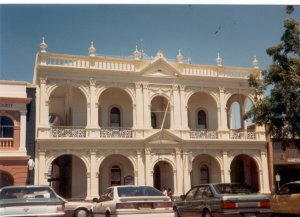
Bundaberg was officially surveyed in 1869. Cultivation of maize was the main source of agricultural income. The first three public reserves were allotted for the School of Arts, Town Hall, and Post Office in 1871. The first School of Arts to be built on the allotment on the corner of Barolin and Bourbong Streets was a small timber cottage with a library and reading room. It was the only building in the town suitable for public meetings so extensions were added as demand required. Of a population of 100, it is not surprising that most of the members of the School of Arts were also members of the Progress Association. This Association applied for municipal status for Bundaberg in 1878. Two years later a larger timber School of Arts was constructed, but it proved inadequate within five years as the town prospered. This prosperity resulted from a boom in sugar cane cultivation, which began with the arrival of the first Kanakas in 1879, and continued throughout the next decade. In order to finance a bigger and better School of Arts, the trustees decided to follow the example of Maryborough and sell part of their land. This required an Act of Parliament, which was duly proclaimed in 1887.
The existing building was moved to the rear of the land, and the sale of the corner section of the reserve gave the committee 3000 pounds. William Calvert began construction of the new building designed by of Anton Hettrich in 1888. The two-storied brick building with cement render featured wide colonnaded verandahs. It was completed in nine months at a cost of 3,300 pounds. The subscription library, invigorated with 1400 new books, and committee room were located on the western side of the ground floor. The rooms on the eastern side were let to businesses to generate income. A wide curved staircase led to the first floor where the reading room, natural museum and chess rooms were located. The huge reading room, which occupied half the floor space, extended the full width of the front of the building. The cool verandahs also served as reading rooms.
The success of the School of Arts could be attributed to several stalwart citizens: one of the first Trustees, William Curtis, an auctioneer and de-facto teacher who established the first school in Bundaberg, was President on four separate occasions and conducted classes for the School of Arts; William Lewis was Secretary for more than 40 years up to 1927; Thomas McIlwraith, M.P. later to become premier and be knighted, sent three cases of standard English classics worth 100 pounds from England in 1880
The ‘Rules and Bye-Laws’ as published in 1902 stated that the objects were ‘the establishment and maintenance of libraries, reading rooms and classes for instruction and generally the diffusion of useful knowledge’. The property was to be divested in five Trustees appointed by a general meeting of members. They were to hold office until death, resignation or removal from office. The management committee elected at the AGM consisted of a president, two vice-presidents and seven committee members.
Full membership was available only to men for one pound per year, a rate which was not increased until 1925. Women, who were associate members, and children included in a family subscription could use a room at the rear of the building only. Country and student membership was offered. There were 243 members in 1913.
The School of Arts opened every day except Sunday from 9 a.m. to 9.30 p.m. The library hours were 10 a.m. to 5.0 p.m. and some evenings. The reading room opened on Sundays. A mezzanine floor devoted to magazines was built around the library at the turn of the century. Salaries were paid to part-time librarians from about this time. The museum continued to rely on a volunteer curator and donations to maintain the displays of butterflies, stuffed animals, beetles, mineral specimens and South Sea Island and Aboriginal artefacts. The museum was administered by a sub-committee.
Another sub-committee administered the library. In 1915 the library housed 18,562 books, of which 15,704 were light fiction. This rose to 44,000 by 1925, with 35,714 being light literature. Subscribers borrowed 50, 000 books from 1929 to 1930. Teachers could borrow for their students courtesy of the Penny Charitable Trust. The reading room held local papers as well as those from Rockhampton and Brisbane. The New York Times and London Society were also available. Magazines included the Bulletin, New Church Magazine, Lone Hand, Farmer’s Gazette, and The Photographic Review. Government subsidies ceased during the depression, and sales tax was imposed on books in 1932, but nevertheless 377 new books and 307 magazines were bought.
Technical education commenced in 1889 with the assistance of a government grant of 250 pounds. A sub-committee was responsible for the administration of the Technical College. The first subjects offered were dressmaking, cooking, mechanical drawing, carpentry, drawing, languages, and first-aid. These were followed over the years by shorthand, book keeping, chemistry, engineering, music, art and taxidermy. Classes were held in the museum and then in a downstairs room until the completion of a new building at the rear of the School of Arts late in 1889. Equipped with a stage and piano, the premises could be hired out when not required for classes. The college was extended in 1906. Following the passage of the Technical Education Act, 1908, the government assumed supervision of Technical Education.
The success of the College was considered to be a factor in the decision to build one of Queensland’s first High Schools at Bundaberg in 1912. Technical classes were then conducted in the high school until the 1960s when a new technical college building was erected. The original Technical College behind the School of Arts was not demolished until the early 1960’s after serving commercial and community functions in later years.
Although the museum closed after World War 1, some items formed the core of a new collection when the Bundaberg and District Historical Museum was formed in 1970. It occupied the original reading room of the School of Arts in 1976.
The transfer of the School of Arts to the Bundaberg City Council was completed in 1980. The following year the library was moved to new premises, and in 1988 the museum also moved out of the building. Part of the ground floor continues to be used commercially, but the remainder of the building serves community needs and provides art and exhibition space. It is very well maintained and remains a significant feature of Bundaberg’s life and streetscape.
Reference:
Bundaberg School of Arts Conservation Study. Report for the Bundaberg City Council, Allam Lovell Marquis-Kyle, Architects, 1993.
Cullen, Enid, Bundaberg Institutes, the History of the School of Arts, funded by the Bundaberg City Council through the Arts Regional Development Fund and Arts Queensland.
“ Bundaberg Institutes, the History of Technical Education in Bundaberg, funded by the Bundaberg City Council through the Arts Regional Development Fund and Arts Queensland.
Walker, J.Y., A History of Bundaberg, W.C. Aiken, Bundaberg, Gordon and Gotch, 1890.
Informatiom from Janet Tallon, City Councillor, 2003.
 Schools of Arts