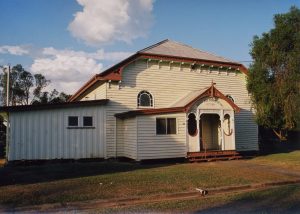
The formation of the school of arts in Forrest Hill was achieved by the efforts of the Farmers’ Progress Association. A site was reserved for a school of arts in 1903, but by 1911 this was transferred to the Fire Brigade, and another site allocated on the corner of Railway Street and Palm Avenue. The school of arts committee in 1911 consisted of six gentlemen, assisted by a ladies’ committee of 17. The Progress Association conducted extensive fund raising and five trustees guaranteed an overdraft of £800 to erect a building complete with stage and dressing rooms. The debt was cleared in 1916 with a combination of government subsidy and fund raising in the form of a Queen Carnival. Sufficient funds were available to build a ticket office on the southern side of the building, and a supper room and kitchen along the western side. The library boasted 1000 books in 1918. For some years the books were housed in private premises. Fire destroyed the secretary’s shop where the books were housed in 1940; fortunately they could be replaced with insurance.
The school of arts played a major role in local life, being home to the CWA and Masonic Lodge. Dances, parties, rallies, meetings, religious services and boxing tournaments were held within its walls. It also served as a doctor’s surgery and baby clinic at one stage.
As a result of war time restrictions in 1941, books were no longer available from the Queensland School of Arts Association, and the library depended on donations. Despite shortages, the stage was improved with new wings and a back curtain. During the 1960s books were received on loan once a fortnight from the State Library. A librarian was employed to look after the library, which was located at one end of the supper room.
Movies became an attraction from 1944 to 1956. The films were projected through a hole in the back wall of the stage on to a screen hung above the entrance. The audience sat on canvass chairs either on the stage which served as the dress circle, or on the dance floor which served as the stalls. The dance floor was replaced in 1960, and in the 60s the CWA provided a new piano and the Indoor Bowls Club donated a refrigerator. A major extension in 1968 provided toilets connected to the new sewage system, a wider supper room and improved kitchen. A new ticket office was built, and ceiling fans installed in 1973. The committee has continued to ensure that the community is well served by a well maintained building.
Reference:
Celebrating 100 Years, Forrest Hill District, Forrest Hill State School Centenary Committee 1993, Forrest Hill State School, Forrest Hill, Queensland, 4342.
 Schools of Arts