Glenville Pike in his book Pioneers’ Country describes Irvinebank as it would have been in 1911:
If one climbed this hill …. one could have viewed the busy town of Irvinebank, seen the smoke from the ninety-foot high smoke stack of the smelters, heard the forty stampers pounding away, the peculiar noise of the big Krupp ball mill, and the continuous blast of the tin smelters and calciners; heard the tinkling bells of the pack teams and seen them winding around the mountainside; seen the clouds of dust in dry times raised by the plodding horse teams; and near at hand was the continuous ”shoof, shoof” of the air compressor at the Vulcan itself. Today there is only silence and a sense of neglect and decay with a handful of rooftops of a township barely clinging to life.1
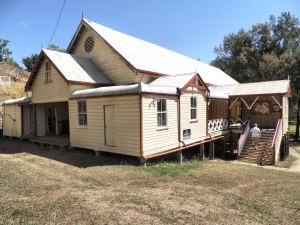
During its hey day the town had two brass bands, a hospital, new post office, school, stores, stockbroker’ office, four hotels, two banks and of course the school of arts, which despite the town’s decline was restored in the 1980s.2
The school of arts was the centre for the town’s entertainment: guest appearances were made by such people as Gladys Moncrieff, who sang there before going overseas to make a career as a world famous opera singer.3 The school of arts served as the ceremonial centre of the town. Pike claims that at least three state governors were welcomed on the lawn area in front of the building. A plaque on a memorial cairn was unveiled in front of the school of arts in 1950 to commemorate the life of John Moffat the mining entrepreneur who was a generous benefactor to the town and the school of arts.
Footnotes:
1Pike, Glenville, Pioneers’ Country, pp. 265, 266.
2 ibid, pp. 263. 266.
3 ibid, p. 202.
Reference:
Kerr, Ruth S., John Moffat of Irvinebank, J.D. and R.S. Kerr, 2000.
Pike, Glenville, Pioneers’ Country, Pinevale Publications, PO Box Mareeba, North Queensland, first published 1976, reprinted 1986.
 Schools of Arts