Mackay is a port and major commercial centre located on the Pioneer River in central Queensland. John Mackay discovered the valley in 1860 and registered the first pastoral run two years later. At the time of the formation of the School of Arts Mackay was a pastoral community whose contact with other colonies depended mainly on shipping. Sugar production and mining were to become the major source of wealth for the future.
The Mackay Mercury, April 3, 1867, published a letter which campaigned for the establishment of a School of Arts:
The advantages inherent in such an institution are almost too obvious to require demonstration. First, it would be the means of providing us with a public reading room, in itself a boon hardly to be overvalued.
In our comparatively isolated position, the southern newspapers form the only link that connects many of us with the older districts of the colony and the only means by which we are made to be acquainted with the topics that are there occupying the public attention.
At present, even the advantages which flow from this source are not as generally enjoyed as they should be, partly owing to the expense of subscription, but no doubt principally to that apathy to all external affairs which isolation engenders in so many. Both of these the institution of a School of Arts is calculated to remove.
There are many other benefits which such an institution can offer a district, such as bringing within reach of all, magazines and periodicals of the old country, providing a public hall for the use of the town and perhaps, greatest of all, affording the means by which a public library might be formed.
Of course the expense which would necessarily be incurred would form a matter for future consideration, but as the local subscriptions would, in all probability be supplemented by a government grant, I cannot imagine that this would be serious enough to counterbalance the advantages gained.
A provisional committee to establish the School of Arts was elected on October 3 1874. The aim was to raise 100 pounds which would be matched by a government grant. By the end of October 91 pounds had been collected with promises guaranteeing the committee more than 200 pounds. The rules of the North Brisbane School of Arts were adopted with slight variations. The reading room opened in the Municipal Chambers on November 16 1874. It operated during the hours of 10 a.m.- 2 p.m., and 7 p.m.-9 p.m. weekdays and 3 p.m.-5 p.m. on Sundays. Mr. H. Hill was appointed as the librarian on a salary of 25 pounds per year. It was the committee’s intention to provide copies of Punch, Harper’s Weekly, Town and Country Journal, London Society, and European Mail, along with copies of colonial newspapers and journals, but initially the number of papers and journals was very limited. The committee was taking steps to develop a collection of books to form a library. Despite the lack of reading material, donations for a new building were accumulating with the help of fund raising activities.
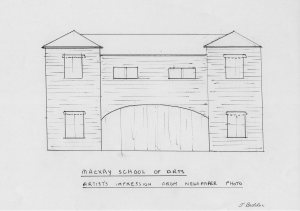
An allotment of land was gazetted under the Crown Land Alienation Act 1876 and the government subsidy was eventually made available. The two-storied timber building was completed in Wood Street by the end of 1879 and opened with a grand fancy dress and calico ball. The lending library and hall were situated on the ground floor, and the reading room on the first floor. The School of Arts was the venue for public functions and meetings such as a gathering held in 1882 to oppose the importation of Indian coolies.
A young man who lived in Mackay from 1882-84 wrote:
There is a nice School of Arts here where there is a good library which I have joined for books are awful dear here. I wish I had brought some with me, I have wished I had brought more luggage for it would pay to sell anything here, there is a fair selection of books at the library and you see the leading newspapers every day or two it comes up in two days, and Sydney news in about 6 or 7 days and we get English papers as well and American. The Illustrated London News among the former. So we see a little how affairs are standing at home.
There are good concerts and Balls at the School of Arts and an opera company was here for nearly a fortnight about a week ago. 1
By the early 1900s plans were underway for another building, and a site on the corner of Gordon and Gregory Streets was obtained by a special Act of Parliament. A large two-storied timber building was occupied in 1912.
In 1903 technical classes were being held during the day, and then a revisal class was introduced in the evening for those whose basic school education was inadequate. In 1904 a teacher, Mr. Perkins, was given the use of two rooms for his classes which were subsidised by a government grant for technical education. During the life of the technical college classes were offered at different times with varying degrees of success: they included book keeping, dressmaking and cookery; the cooking classes were held in a local shop. In 1908 the government offered to provide four-fifths of the amount needed to build technical colleges. A public meeting was held and a committee was formed to raise funds. The State Technical College opened on February 21, 1912. It was built adjacent to the High School and initially shared the same principal. When the High School moved to new premises, the technical College occupied all the buildings.
The School of Arts was fortunate to narrowly survive the economic downturn in 1923. Measures were taken to generate income in the ensuing years. The ground floor was extended to accommodate the reading room to allow the lease of the first floor to radio 4MM in 1950. Other income was received from the Library Board of Queensland and Mackay City Council. Parking space in the grounds also generated income. Extensions and improvements were made in 1960. The library was very active: in 1978 with a stock of 29,000 volumes and 1160 subscribers.
The School of Arts was transferred to the Mackay City Council in 1980 and demolished shortly afterwards. A new library was opened next to the municipal offices.
Footnote:
1 Hislop, Booth, Howlett, Myers, (eds), The Making of Mackay and the Pioneer Valley 1860-1918, Central Queensland University Press, 1995., p.59.
Reference:
Information kindly provided by Mr. Gordon Noscov, Municipal Councillor and former Technical College administrator of Mackay. His comprehensive article on the School of Arts appeared in the Daily Mercury, Saturday June 26, 1980.
Information provided by the Mackay Historical Society.
Hislop, Booth, Howlett, Myers, (eds), The Making of Mackay and the Pioneer Valley 1860-1918, Central Queensland University Press, 1995.
 Schools of Arts