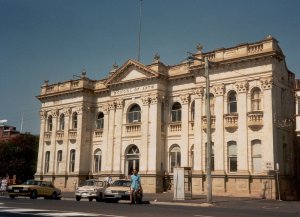
Rockhampton developed as a major port 75 kilometres inland from the mouth of the Fitzroy River. Early settlers were attracted by the gold discoveries in the area. As early as 1855 Mr. John Palmer established a store in a bark hut and kept ‘a parcel of standard works of the most celebrated authors’ for those who wished to read.[1].
The first land sales were held in 1858. The land document of 17 November 1960 indicates an allotment in Bolsover Street reserved for the School of Arts; this was gazetted in March 1861. The trustees of the land were Mr. John Jardine the Police Magistrate, Reverend Samuel Kelly, and John Alexander Lanarch.
Following a public meeting in July 1861, the rules for the School of Arts were compiled, officers appointed, and an application made for the use of the land. Mr. John Douglas M.P. opened the School of Arts hall in February 1865. His reference to John Palmer as the first president raises the possibility that an unofficial School of Arts was operating well before the official election of the first president. The court house accommodated the initial reading room to which Sir Charles Nicholson, the patron made a substantial donation of books. Mr. John Jardine gave the first lecture on the ‘History of the Schools of Arts’, and monthly lectures, discussions and debates were organised. A hall was opened in February 1865 with the help of government grants and public donations. At this time members paid a subscription of one pound, which was the amount still charged in 1897. Classes were offered in Greek, Latin and Music and members could attend lectures and functions of the music society. Initially no dancing was permitted in the new hall, but, when permission was given, gentlemen were required to advise the committee of their partners’ identities.
A second building was erected in front of the hall in 1866: this accommodated a reading room on the ground floor and museum on the first floor. The illustration which is often used to represent the first School of Arts is misleading because it is an artist’s impression of the plans for the building: lack of funds meant that the verandahs and ventilator on the roof were not added.
By leasing the corner section of their land to the Hibernian Hotel, the trustees were able to generate income. This increased in 1869 when adjoining land was granted and additional sites along William Street could be leased commercially.
The School of Arts buildings multiplied during the 1870s and 80s: the library became the librarian’s residence and a new library and museum were built. The Australian Handbook and Almanac of 1875 records that the library contained 1900 volumes. Improvements included gas lighting and an upgrade for the hall. A ladies’ reading room was made available for six months in 1885, but it closed because of lack of interest. A new residence for the secretary was needed by 1890.
An Act was passed by parliament in 1892 allowing the committee to mortgage the site along William Street to raise funds for a new building. The museum, reading room complex in Bolsover Street was demolished and a new building erected adjoining the original hall. The building and secretary’s residence were completed by Mr. W.A. Lawson at a cost of 6325 pounds. The opening on 7 March 1894 was marked by a public holiday. The two-storied cement rendered brick building was 95 feet wide and 155 feet long. The frontage to Bolsover Street featured a central entry bay flanked by recessed bays and wings. The classical design featured pilasters rising through the two floors, arched windows with balustrades on the first floor, and pediment and decorative parapet on the roofline. The entrance led into a vestibule which extended the length of the building to give access to the older hall beyond. Cracks caused by the area’s unstable clay subsoil were appearing in 1895 and in 1899 repairs were necessary.
A fully equipped recreation and billiards room was added in 1903. The hall was extended and upgraded in 1910 providing two new balconies and a supper room under the stage. It became a venue for concerts, balls and theatre productions. In 1932 the facilities offered by the School of Arts included a library with more than 31,000 books, committee room, main hall which could seat 1050 people, dressing rooms, cloak room, and a kitchen; on the first floor there was the gallery of the hall, separate reading rooms for men and ladies, and a museum.
Technical education commenced in the School of Arts around 1896 with classes in shorthand; mechanical, freehand, and model drawing; German; ladies’ painting, and French. A shed, which was built for museum specimens was extended for carpentry classes. In 1897 the Technical College operated under an independent committee but continued to rent rooms from the School of Arts. By 1903 it was aspiring to its own building, and in 1909 leased a rear portion of the School of Arts property for a chemistry and science laboratory.
Accounts in 1939 showed receipts as 2549 pounds and expenses as 7200 pounds. It is not clear as to whether this included income form leases.
The building was transferred to the Rockhampton municipality by an Order-In Council in 1946. It continued to serve the community. Rooms were occupied by the Rockhampton and District Historical Society from 1950 to 1983, and by the Rockhampton Regional Promotions Bureau from 1959 to 1971. The University of Queensland operated its external studies centre on the first floor from 1967 and in 1969 150 students were enrolled.
The problems with moving foundations continued to plague the building and investigations were made in the mid-sixties. The costs of repairs proved uneconomical and in the interests of public safety the building was closed by the end of the eighties. The Council is obliged to observe the heritage listing and in 1992 was seeking interest in redevelopment of the building.
Reference:
Request by the Rockhampton City Council for expressions of interest in the redevelpopment of the School of Arts. 14 July 1992. Document held in the Rockhampton Municipal Library, vertical file L. Z – 584.
Information from Sue Palmer-Gard of Kabra, Queensland. Sue researched information on the School of Arts for the Rockhampton City Council.
Murdoch, Wayne, Pioneering Culture.
Foonote:
[1]Bulletin, Rockhampton, 13 July 1861, p. 4.
 Schools of Arts