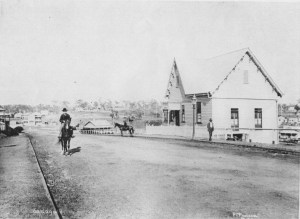
The story of Sandgate’s small suburban school of arts and its technical college is told in the receipt and minute books kept in the Queensland State Archives, and newspaper records researched by Grace Beecher and kept by the local historical society. The bay-side township 25 kilometres from Brisbane was established in 1853. The mayor called a public meeting in 1886 to propose the formation of a school of arts. A timber building was erected at a cost of 550 pounds on a sloping block of Crown land on the Upper Esplanade where the Senior Citizens Hall now stands. It had two large rooms at street level and another large room underneath for public use. It opened with a converzatione in 1888 at which the Attorney General spoke of the importance of schools of arts in education.1
By 1924 the school of arts boasted a library containing 4000 volumes of modern fiction and reference, a comfortable reading room and verandah lounge open from 2.0 p.m. to 5.0 p.m. and 7.0 p.m. to 9.0 p.m. Subscribers paid two shillings a month or five shillings a quarter.2 On 31 October 1934 the Brisbane Courier reported that there was a chess club, radio club, a piano and a music room available for subscribers.
Moves were made to establish a technical college in 1896 when 100 pounds was voted in the estimates, but it was another two years before the college opened. The minutes of the technical college committee from 1924 to 1939 were kept in a thick exercise book. At each meeting the secretary rarely used more than two pages to record the reading of the previous minutes, the passing of expenditure, treasurer’s report, and any correspondence. The names of the individuals on the technical school committee were not recorded because the meetings were held after the school of arts committee meeting and the members were one and the same. Government regulations permitted municipal technical colleges to have school of arts members on their committees, whereas committee members of large regional technical colleges were required to be completely independent. The subjects offered over the years reflected the demand at particular times. Commercial classes were well attended from 1913 to 1915, but in 1925 a local teacher could not be found, and classes were not financially viable. Cooking and dressmaking were offered on a regular basis. In addition to adult classes, it provided instruction to pupils from neighbouring primary schools until the 1930s, receiving a set fee per student from the Department. Visits from departmental inspectors occurred intermittently. The college assisted the finances of the school of arts by payment of rent for rooms, and contributions to the gas and electricity expenses, and secretary’s salary.
It was only in the minutes of March 1939 that the committee members were named individually, because the meeting was called separately from the committee of the school of arts. It needed to consider the proposal to let the upstairs room to the Department of Public Instruction. for one pound a week for a period of twelve months with an option on monthly rental after that time. The room was to serve as a permanent domestic science facility run solely by the Department, In the following June the college closed and the balance of its account was handed over to the Department.3 The school of arts continued to provide a service to the community as the town library, Penny Bank branch, venue for social events, lectures, and Masonic celebrations. It was the Minister for Education who announced that the Brisbane City Council was to take over the school of arts in 1952. The library was moved to the town hall and permission obtained from the state government to demolish the building in 1959 because of its state of disrepair and unsafe foundations.4
Footnotes
1 Brisbane Courier, 19/3/1888.
2 Brisbane Courier, 31 October, 1924
3 Sandgate Technical College, Commercial Papers, Minute Book, 30/01/1914 to 30/06/1939, PRV11399, QSA
4 Echo, May 13, 1959.
References:
Sandgate Technical College, Commercial Papers, Minute Book, 30/01/1914 to 30/06/1939, PRV11399, Queensland State Archives.
Brisbane Courier
The Echo
 Schools of Arts